Freight Shipping from Russia to Armenia: Methods, Transit Times, Costs and Documents
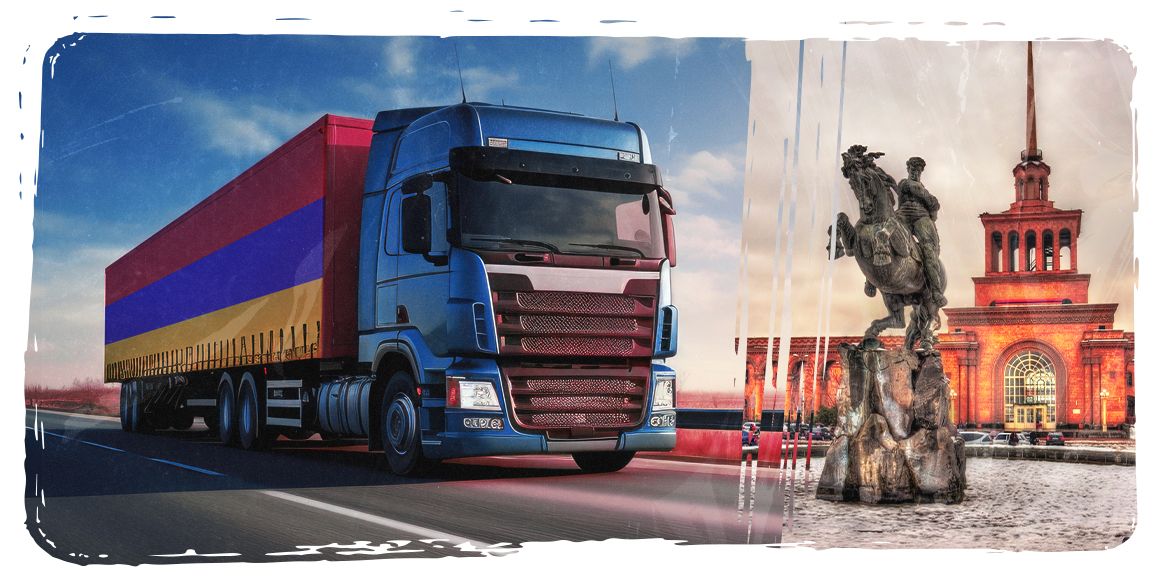
Armenia is a member of the Eurasian Economic Union, yet it shares no land border with Russia. Every truck running from Moscow to Yerevan therefore transits a third country — Georgia — and that single fact shapes transit times, pricing and paperwork alike.
Shipping methods
Road freight
The primary channel, carrying most of the volume. It works both for full truckloads (FTL — curtainside, reefer, insulated) and for groupage shipments (LTL), where you pay only for the space or weight you occupy.
The route is almost always the same: Moscow → Rostov-on-Don → Vladikavkaz → Upper Lars → Georgia → Bavra or Bagratashen → Armenia. Upper Lars is the only operating road crossing between Russia and Georgia, and it is the bottleneck of the entire corridor.
Groupage (consolidated cargo)
The best fit for anything from a few boxes to a couple of pallets, and for relocations and personal effects. Cargo is consolidated at a Moscow warehouse, waits until the trailer is full, and travels on a shared run. Cheaper per unit than a dedicated truck, but adds 2–5 days of consolidation time.
Air freight
The fastest option: 1–3 days door-to-door to Yerevan. Justified for documents, samples, electronics, and spare parts covering production downtime — anything where the cost of a missed deadline exceeds the cost of shipping. Expect size limits and a strict list of prohibited items.
Rail
There is no direct rail link between Russia and Armenia; the line through Abkhazia is out of service. The workaround is multimodal: rail or sea to the port of Poti in Georgia, then road to Yerevan. Worth considering for large consignments, heavy and out-of-gauge cargo where the per-tonne saving outweighs the time lost.
Method comparison
| Method | Transit to Yerevan | Best for | Constraints |
|---|---|---|---|
| Full truckload (FTL) | 8–12 days | From 10 t or 40–86 m³ | Border queues |
| Groupage (LTL) | 10–16 days | 1 box — 3 pallets | Consolidation wait |
| Air | 1–3 days | Urgent, valuable, light | Dimensions, cost |
| Multimodal (Poti + road) | 15–25 days | Heavy, oversized, bulk | Transshipment, season |
Transit times: why 8–12 days, not 4
Pure driving time from Moscow to Yerevan is roughly 3–4 days. The rest is consumed by:
- the queue at Upper Lars — anywhere from a few hours to several days; in winter the pass closes for avalanche risk and heavy snow;
- customs transit clearance on entering and leaving Georgia;
- consolidation of groupage cargo at the origin warehouse;
- unloading and release at the Yerevan warehouse.
Practical takeaway: if the deadline matters, plan against the upper end of the range and never schedule a delivery flush against the due date. Delays peak in late December, January and the run-up to public holidays.
What drives the cost
Pricing is never a clean per-kilometre calculation. The main factors:
- weight and volume — the greater of the two applies (volumetric weight);
- trailer type — a reefer runs 25–40% above a curtainside;
- cargo nature — hazardous, perishable, temperature-controlled or requiring insurance;
- direction and backhaul — if the truck returns empty, that is priced in;
- season — rates climb ahead of holidays.
As a market reference point, a full 20-tonne Euro trailer from Moscow to Yerevan starts around ₽180,000–200,000; groupage is quoted per cubic metre or per kilogram. These are indicative figures, not an offer — a real rate requires a quote against a specific load and date.
Documentation
As an EAEU member, Armenia charges no customs duty on goods imported from Russia. But transit through Georgia — a non-member state — adds procedures that shippers routinely overlook.
Standard pack for commercial cargo:
- commercial invoice with description, quantity and value;
- transport waybill: CMR for the international leg, a domestic consignment note for the Russian leg;
- packing list;
- supply contract or agreement;
- statistical reporting form — filed with Russian customs for intra-EAEU trade; the most commonly forgotten document and a frequent source of fines;
- certificates of conformity, declarations, veterinary or phytosanitary paperwork depending on the commodity.
For Georgian transit, a customs transit procedure is opened as well — normally handled by the carrier or a broker.
For personal effects and relocations the pack is simpler: an itemised list with declared values, a passport copy, and where relevant, proof of change of residence.
Tip: reconcile item descriptions across the invoice, packing list and waybill before the truck departs. A single mismatched line means hours of border delay, and occasionally a full reload.
What happens after arrival in Yerevan
An international carrier almost always delivers to a Yerevan warehouse — and that is where its responsibility ends. From there, domestic logistics take over: onward delivery to Gyumri, Vanadzor, Abovyan, Kapan, or a specific address out in the marzes.
This is a separate problem with a separate market. Buying the last mile from your international forwarder is usually more expensive than sourcing a local carrier directly: Armenian trucks often have a backhaul running the right way and will take a partial load below market rate.
That is exactly the gap Busy Track closes — a marketplace matching cargo with carriers inside Armenia. Post a listing with your route, cargo type and date, and receive offers directly from drivers, with no intermediaries and no markup.
Key points
- Road is the main mode from Russia to Armenia: 8–12 days, transiting Georgia.
- Transit time is set by the Upper Lars queue and the season, not by distance.
- EAEU membership removes duties, but transit clearance and the statistical form remain mandatory.
- After Yerevan, the last mile is cheaper booked with a local carrier.